Amelie Mallmann
Dance is Telling
Contribution from the booklet “Modes of Play for Young Audiences”
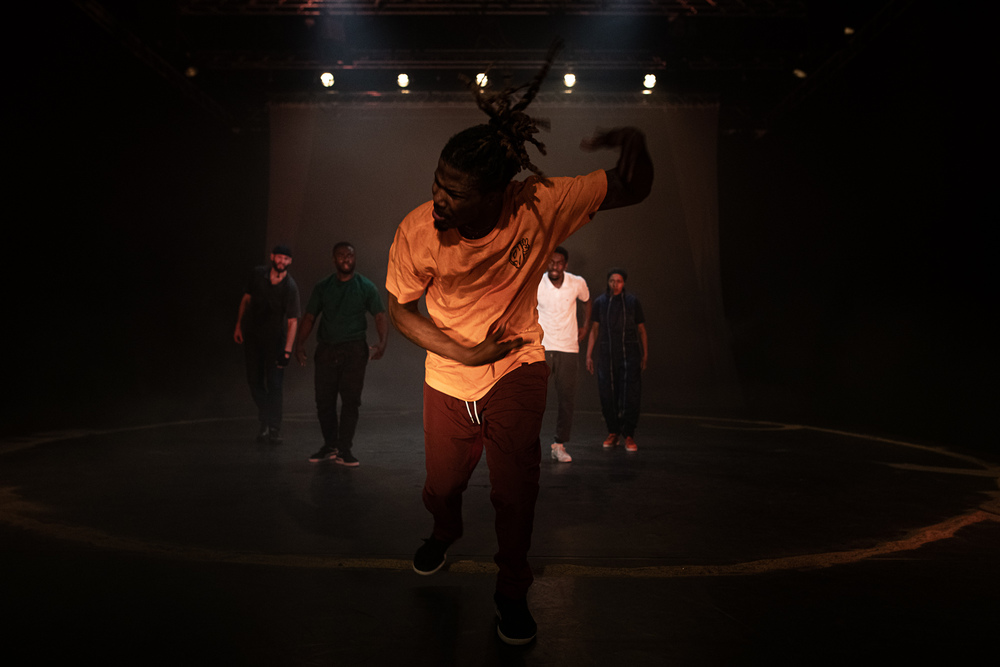
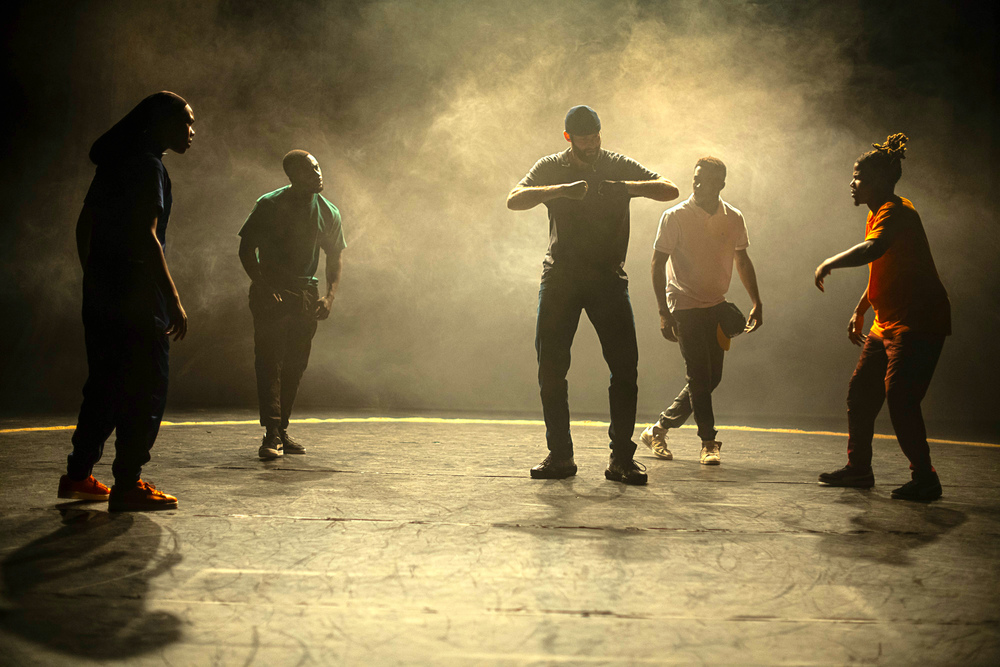
A dancer and four dancers stand outside a large circle of sand. The atmosphere is tense, the light gloomy. No sound can be heard. But then one begins to move, slowly but powerfully he stamps up with his leg. The arm moves upwards, the whole body follows the impulse. His movements are called stomp and jab: While the stomps anchor the feet in the earth and bring stability, the arms stretch towards the sky with the jabs, collect energy and hurl it into space. Slowly the others move, not only her body, but also her facial expressions begin to dance. Then the music begins: Le Sacre du Printemps by Igor Stravinsky.
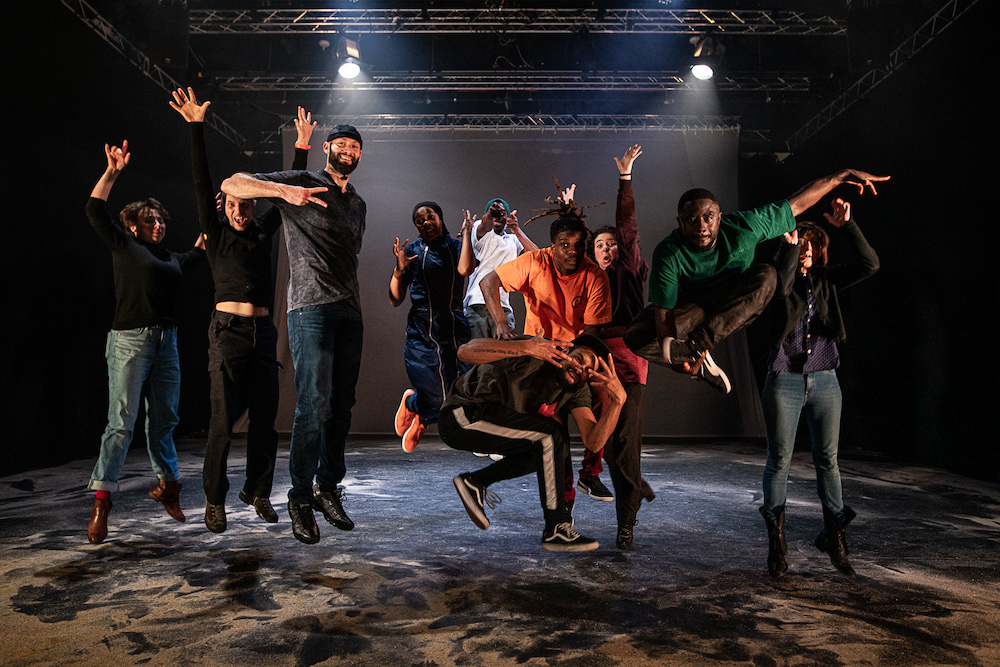
This opening scene from the dance piece A Human Race – The Rite of Krump by French choreographer Grichka Caruge establishes each figure with its own way of moving. The slowness expresses caution, a watchful waiting what will happen to the group. The tension rises through the silence, which is then surprisingly broken by the music. Now begins the story of this group, which neither chronologically nor verbally spins before the eyes of the youthful audience from the age of 11. It is the story of five people who have experienced discrimination and find in their dance an outlet for suppressed feelings. The community offers them the shelter to show themselves relentlessly.
The style in which this happens is called Krump. Created around the turn of the millennium in the Los Angeles Black Community, Krump seems aggressive and angry on a superficial level. The stomping legs, the swinging but also beating and threatening arms, the distorted facial expressions – but Krump is much more. It is danced resistance, it puts the body in a kind of emotional trance, in which all feelings may come to light.
A Human Race © René Löffler
The piece is currently in the program of TANZKOMPLIZEN, a venue in Berlin that exclusively shows dance for young audiences. Confronting young people with an urban dance style and a piece of music from 1913 is a risk, as they have to engage in emotions whose vehement expression hardly allows any room for retreat. What does the dance tell them, what do the bodies that dance in rage tell them? The audience perceives that the body is able to transform feelings outwards by shaping and shaping the movements in a certain way. The body functions as an archive: All muscles, tendons, skin, bones, all fluids and organs store sensations, experiences, traumas. How we move shows who we are and what we have experienced.
On a stage, many things can be conveyed through words, but only through body language can the content of a message actually be experienced.
In the case of A Human Race, movements make it clear: The dancers fight against borders that are set from the outside, but also against those in their own minds. They dance against racism, against exclusion and dehumanization. They dance for a strong community, for truthfulness and mutual support. To top it off: They dance for their lives. Where a purely intellectual or verbal solution remains a mere assertion, the body can have its own who we are and what we have experienced. On a stage, many things can be conveyed through words, but only through body language can the content of a message actually be experienced. In the case of A Human Race, movements make it clear: The dancers fight against borders that are set from the outside, but also against those in their own minds. They dance against racism, against exclusion and dehumanization. They dance for a strong community, for truthfulness and mutual support. To top it off: They dance for their lives. Where a purely intellectual or verbal solution remains a mere assertion, the body can find its own way out. By empowering, encouraging, stabilizing and sensitising oneself through movement to reactions to the movements of others.
If you dance alone, you need access to your own feelings and the will to design. Then almost everything can be translated into motion. Then the way becomes clear to express oneself without words and to let go of stored emotions.
This is a message that can be especially relieving for young people who go through a labyrinth of contradictory sensations and are not sure what they are allowed/wanted to say and what they are not.
When dancing in a group, everyone needs empathy to absorb impulses and use them as inspiration for their own movement. Dancing together tells how individuals can tune in to a common rhythm by paying attention to each other; But it also tells how this creates a community in which individuals can cheer, support and strengthen themselves.
Let's move away from the concrete example of A Human Race and look at the dance history: from folk and tribal dances to court dances to ballet, from expressive dance to modern and postmodern dance to the urban dance forms we know today – dance was and is universal, as every person with a body can also dance.
On the other hand, dance is culturally and historically shaped and truly not, as is so often said, a language that everyone understands.
Children and teenagers who have never seen a dance piece are surprised and sometimes irritated by what is happening on stage. It is not so easy to trust one's own perception and let danced movements have a value-free effect. At best, the own mirror neurons are fired up and there is a desire to dance with them – this is also an act of empathy.
In the mediation, i.e. in the accompanying workshop or follow-up discussion, work can be done on three levels and the narrative of dance can be traced: Physically, emotionally and mentally.
What movements have remained in memory, can they be traced again, without words?
What was the quality of the movements: flowing, angular, fast, slow, expansive or very close to the body?
What feelings were felt while watching?
What movements have caused these feelings?
What was thought and remembered while watching?
Thus, the storytelling of dance is extended by a physical and emotional effect, which enriches the cognitive, on which otherwise so much value is placed in our everyday life, many times over.
Dance is an invitation to understand oneself as a holistic being and movement as an integral part of our lives. He teaches respect for the body of others and raises awareness of vulnerability and the possibility of empowerment.
Amelie Mallmann is a dramaturge and dance educator. Since 2018 she has been working for TANZKOMPLIZEN – Tanz für junges Audience, before that she was engaged at the Landestheater Linz, the Theater an der Parkaue and the Deutsches Theater Berlin and has worked as a freelancer for the ‘Kunstfest Weimar’, the ‘Festival Theaterformen und ‘Augenblick mal! – Theatre Festival for Young Audiences’. She was on the board of the Dramaturgical Society and is currently co-director of the certificate course ‘Biographic-Documentary Theatre’ at the University of the Arts Berlin. E-Mail: mallmann@tanzzeit-berlin.de
This text has been published in AG Jugendliteratur und Medien - AJuM (ed.): “Modes of play for young audiences. Insights into the Children’s and Youth Theatre”, kjl&m 22.2 | forschung.schule.bibliothek, Munich 2022.
A Human Race © René Löffler