Michaela Schlagenwerth
Another network for dance?
Impressions from the "Futur Tanz II" conference
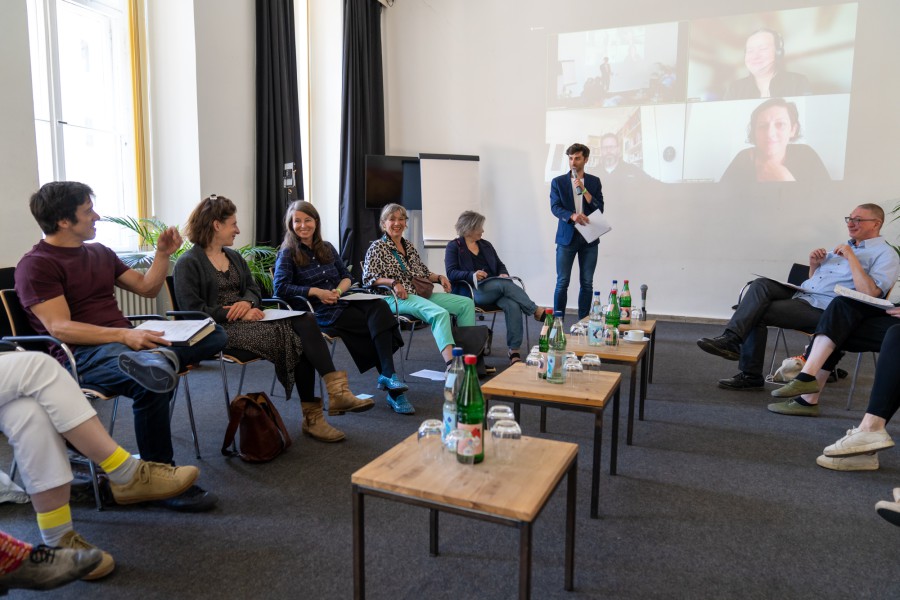
Another network for contemporary dance? Just don't! Or is it? In the past three decades, contemporary dance has created so much network throughout Germany and especially in Berlin that you hardly have an overview from the outside. With Aktion Tanz, a strong network has also been established for dance education. So why more? Who should spend all this time and energy to sit in even more committees and generate new meetings themselves?
After the second conference "Futur Tanz II: Coming into action’ in May (after Futur I in January) you go home with the surprising realization that another, a new network for contemporary dance is needed. Definitely even.
In January, Futur asked Tanz I ‘On the move to the section?’ and already stated with the question of what the dance is not for young audiences, but should actually be – a separate section. Although there are now more funding pots and accordingly, the productions of professional dancers and choreographers have been able to develop significantly for young audiences, both qualitatively and quantitatively. But young dance is still a long way from establishing itself as a separate branch in addition to children's and youth theatre. But there is nothing else that can be done in perspective.
The fact that dance as an art form plays a correspondingly more important role in an increasingly digitalised world - especially for children and adolescents - is now, to a certain extent, a consensus in cultural policy. But nothing will move through the dance scene without initiative.
How, then, can temporary support, such as ‘Offensive Tanz’ itself, be sustained and expanded? Without a long-term and professional network, i.e. working with paid jobs, this will not be possible. The conference “Futur II” has made this clear, but it is itself a complex matter.
• Which work assignments are linked to the establishment and expansion of a dance division for young audiences?
• What understanding of dance is meant and how broad is that?
• How are the different structures of urban and rural areas taken into account?
• How can concepts be developed that do justice to both?
• And: What does it mean to set it up in such a way that equity - i.e. equality, equal opportunities and power-critical diversity - is the starting point?
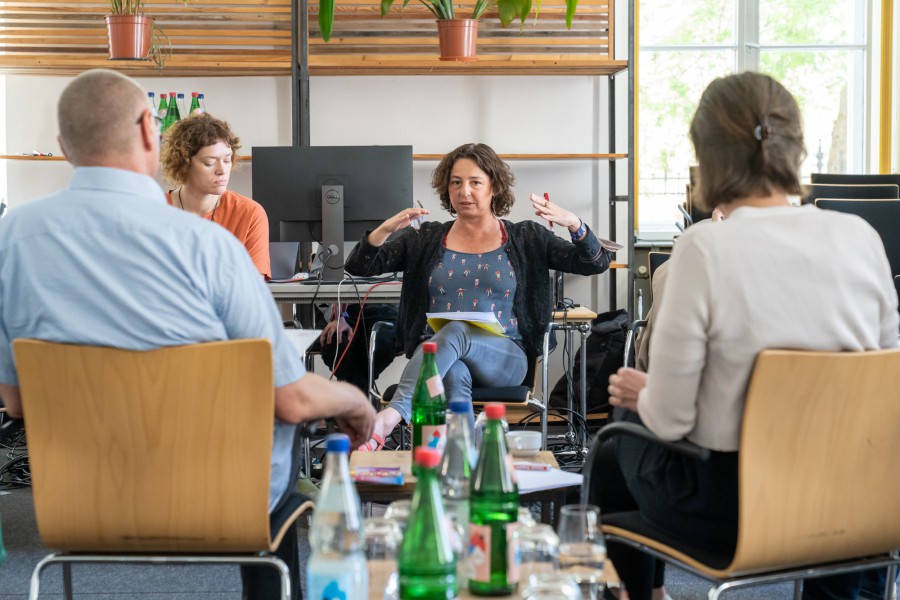
At the Futur II conference, there was a bewildering array of ideas for what such a network could do. Ultimately, this has made it clear what the new network absolutely needs - a very clearly focused, goal-oriented mission. It is certainly not possible to build up dance as a new branch for young audiences without the appropriate support of dancers and choreographers.
In order to generate young audiences, especially the adults, the teachers in the school must be considered. There is a need for extensive mediation and development work in this field.
How can this be done? Anyway, what content is it about? What can thematic priorities look like, which might also bring schools closer to dance in principle? For example, by corresponding with the framework curricula? Young dancers and choreographers must be encouraged. It takes exchange with each other in order to learn from each other and to develop together.
Does all of this – and more – belong in such a new network that aims to establish a dance sector for young audiences? Which orders are necessarily linked to such a network? Which ones might be better off at Action Dance? Which should be handled, hand in hand, by both networks?
Only one thing seems clear: At its core, the new network will have to deal with where the dance sector can find its place or places for young audiences and where and how it can find appropriate support. Exploring further specific requirements is likely to be the subject of even more than just a conference. Until then, however, in the hopefully not too distant future, exactly such a network can be established.